Thanks for telling it to me straight, Marjane Satrapi.
Reading her graphic novel Persepolis about growing up during the Iranian Revolution felt like I was sitting down to talk with her about her life. A lot of stereotypes I’ve carried around have come unraveled by learning how her experiences were shaped by the political and religious chaos of her country’s regime.
Let’s face it, I grew up rocking to Michael Jackson and wearing ripped t-shirts and leggings like Jennifer Beals in Flashdance. So, the idea of being forced to wear a veil at school is very strange to me. OK, let’s talk about the veil. Take a look at this example of how the illustrations in Persepolis really show how that culture is foreign to mine (and maybe yours). Right off the bat, the opening frames here show a group of young girls covered in veils. This is followed by an image of the Islamic Revolution, and then of the little girls finding creative ways to escape their veils (Satrapi 3). You get the message this was part of the values and political ideology in Iran.
Let’s face it, I grew up rocking to Michael Jackson and wearing ripped t-shirts and leggings like Jennifer Beals in Flashdance. So, the idea of being forced to wear a veil at school is very strange to me. OK, let’s talk about the veil. Take a look at this example of how the illustrations in Persepolis really show how that culture is foreign to mine (and maybe yours). Right off the bat, the opening frames here show a group of young girls covered in veils. This is followed by an image of the Islamic Revolution, and then of the little girls finding creative ways to escape their veils (Satrapi 3). You get the message this was part of the values and political ideology in Iran.
 |
| The Veil |
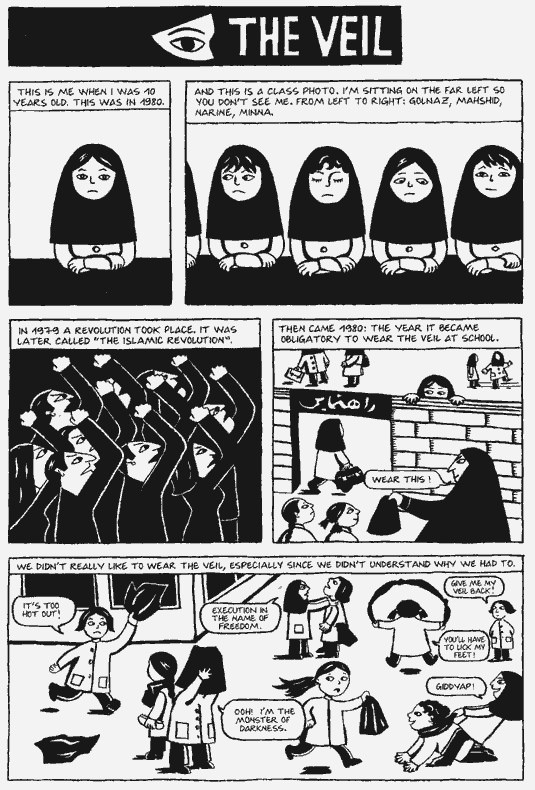
Satrapi, Marjane. Persepolis: The Story of a Childhood. Pantheon, 2003, p. 3
I’ve always had the freedom to wear what I want (even the bad choice of parachute pants). So learning how the veil symbolizes something important to Iranian women (like repression for some) was a new concept. Their strict dress codes (pretty much black), and even stricter rules about what’s right or wrong are all unfamiliar to my Western culture. Are Satrapi's stark black and white illustrations (no frilly techniques like cross hatching for her) unplanned? I think not. They deliberately express the feeling that, in many way, Iran is a very black-and-white country.
A lot of the details of Satrapi’s images produce a sense of something foreign. She includes icons and experiences specific to Iranian culture, like the ancient ruler Cyrus the Great (Satrapi 28). An Eastern art influence embellishes dream sequence images, along with a Persian miniature art style that seems poetic. Satrapi uses repeated visual elements, like police crowds or missiles, but makes no attempt at three-dimensional realism. This gives the idea of movement and danger, but at a distance. I am reminded that politics in Iran are life-or-death.
Persepolis also works with the comic concept of lines drawn in a certain way to represent different emotions (McCloud 124-126). Its panels express a mood to readers, saying something about characters and their psyches. Looking at the heavy blacks and bold lines changes how I understand their meaning and tone. There’s a distinct impression of being inside a foreign world that’s grim, even deadly.
But, wait. These same cartoony, iconic illustrations also make things feel familiar. How’s that, you ask? It’s like this. The book's simplified drawings have very little detail in faces, even appearing symbolic. They represent something that’s recognizable enough for my mind to relate to their shapes. I identify with the characters, even though they’re so foreign to my culture. The comic theory for this is that a simple abstract image encourages you to more easily become that character. The very cartooniness of Satrapi’s drawings lets you see yourself in Marji (McCloud 42-43).
Using a child narrator in the familiar Western comic form is a way to create a more universal understanding. Satrapi’s story might be entirely different to mine (and probably yours), but Marji’s very human experiences cancel out a lot of differences. Persepolis becomes even more recognizable to me through Western culture images like Marji’s denim jacket with a Michael Jackson button (Satrapi 131).
Stepping back to look at Persepolis' world helped me think about things like that country's inequality and dangerous politics. Through her graphics, Satrapi showed me how she came of age just as things got worse in Iran. Women’s rights were disappearing and even the suspicion of being a spy could get family members executed. She taught me that people in non-Western cultures like Iran view Westerners as the other. Surprise! We usually feel the same about them. And without trying to, I learned the history of her homeland's political eruption. Persepolis' iconic art helped me see Iran as more than just an abstract concept.
I’m ashamed to admit I’ve mostly bought into media hype that shows Iranians as fanatics. That was my only image of Iran, so my view was slanted and unfair. This book told me that wasn’t even close to the truth. Unfortunately, I live in a world (especially after 9/11) that often suspects Iranians of being the “the bad guys.” My worldview needs to change because they’re people just like me and you, aren’t they? They’re individuals and so don’t like being stereotyped. Reading Persepolis didn’t just show me what it was like to grow up in Iran at that time. It also shared the pain of being misunderstood because of where you’re from. As global citizens, we can all relate to that human experience. Right?
Works Cited
McCloud, Scott. The Invisible Art Understanding Comics. HarperCollins Publishers, 1994, pp. 42-43, 124-126.
Satrapi, Marjane. Persepolis: The Story of a Childhood. Pantheon, 2003, pp. 3, 28, 131.
Comments
Post a Comment