Use the word comic book to anyone and you can almost guarantee they think of superheroes and blazing colors. But investigative journalism into war-torn zones? Nah! Actually yes. Comics are not just for kids. Sometimes they answer probing questions about a culture or situation.
Cartoonist Delisle did just that while working for a French film company. He recorded the culture of one of the last communist societies, the capital of North Korea. Through his graphic novel Pyongyang, Americans get to see a strange country. His sparse line work in humorous, simple vignettes really gives us a feeling of that culture’s monotony. This society seems to be all out of imperfection and dissent. Detailed scenes of the narrator’s boring everyday activities are shown, even down to him noticing the kind of bulbs in his hotel room (Delisle 22). These small moments and actions help us feel more connected to the country.
Safe Area Gorazde’s comic book format, by wartime journalist Joe Sacco, does the same thing with the story of the Bosnian War. It seems more familiar to us as Sacco steps back to let people share their own stories. We see the problems of regular folks from this personalization. Hey, it’s hard to care about those dying when we don’t even know their names, much less tragedies. So Sacco’s panels showcase the human aspects of the Bosnian War for us. We see its reality up close. After all, it’s the details that make us care about a story.
The power of graphic novels is their individual voices let people get to know new and different places. Without even leaving the house. Readers use the comic principle of closure in the space between panels and fill in their experiences to interpret events (McCloud 64). This is how Safe Area Gorazde helps us connect to Yugoslavia. Hey, it’s just a strange place hidden away in Europe we don’t really care about. Right? But we see the terrible chaos of the Bosnian War through Sacco’s book. His realistically drawn characters show us these people are ordinary, not just distant stories. His character development draws us into the larger events in Bosnia.
Safe Area Gorazde’s comic book format, by wartime journalist Joe Sacco, does the same thing with the story of the Bosnian War. It seems more familiar to us as Sacco steps back to let people share their own stories. We see the problems of regular folks from this personalization. Hey, it’s hard to care about those dying when we don’t even know their names, much less tragedies. So Sacco’s panels showcase the human aspects of the Bosnian War for us. We see its reality up close. After all, it’s the details that make us care about a story.
The power of graphic novels is their individual voices let people get to know new and different places. Without even leaving the house. Readers use the comic principle of closure in the space between panels and fill in their experiences to interpret events (McCloud 64). This is how Safe Area Gorazde helps us connect to Yugoslavia. Hey, it’s just a strange place hidden away in Europe we don’t really care about. Right? But we see the terrible chaos of the Bosnian War through Sacco’s book. His realistically drawn characters show us these people are ordinary, not just distant stories. His character development draws us into the larger events in Bosnia.
Some of the images in Safe Area Gorazde tell you all you need to know about the story. They can carry the weight of a scene without words (McCloud 157). Take a look at this illustration on page 80 from “The First Attack” of the women and children escaping to the river. Nope, no words needed here. You can hear their screams in your head and the thud of their running feet.

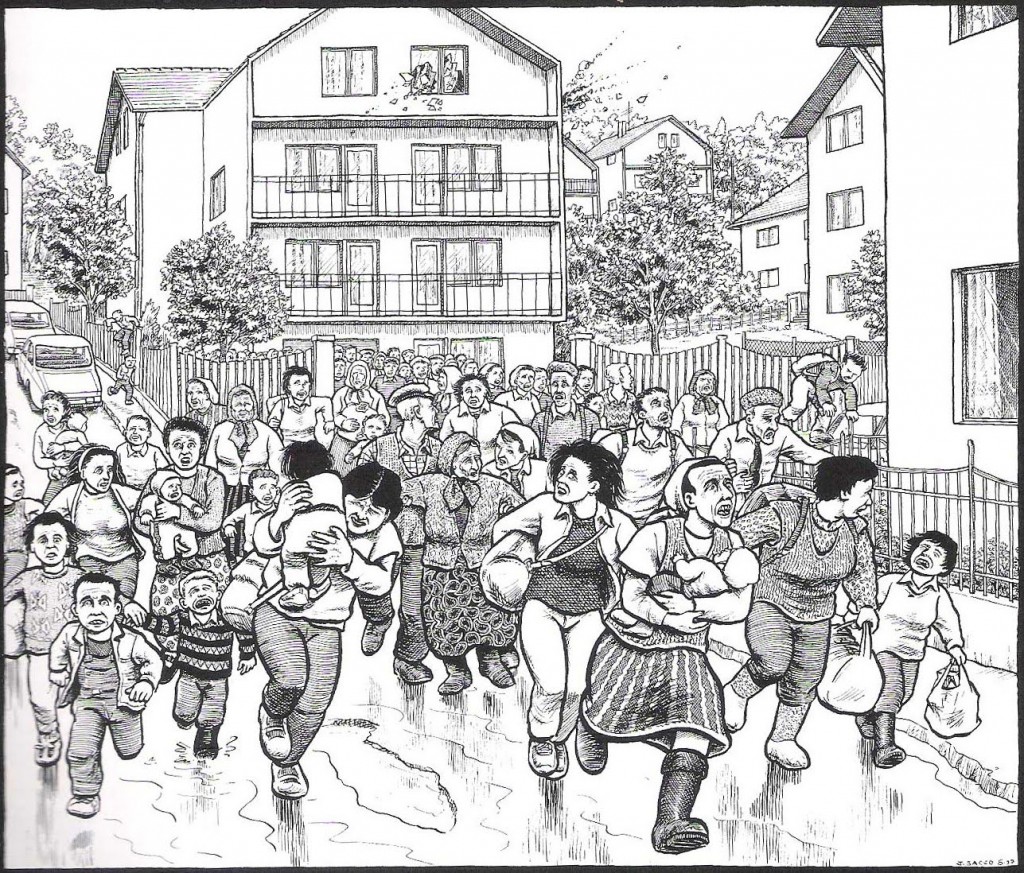
At other times, a single image just can't really describe a scene on its own. Likewise, sometimes text needs pictures. This interplay between words and visuals really enriches a story (McCloud 156-157). Given the journalistic style of Safe Area Gorazde, narration offers important details that speech bubbles just can’t. But this doesn't stop how the story flows. Just the opposite. Unique placement of text physically takes the reader through the plot, while speech bubbles help to add personal details or opinions of interviewees.
Pyongyang’s no slouch. It also uses an interesting balance of text with images in its panels. This collaboration between words and pictures beefs up the story (McCloud 156-157). For a more minute-by-minute reporting feel, narration combines with speech bubbles. They don't just lead us through the events, they actually give us an inside look at Delisle’s thoughts.
You can tell from these panels how important combining text with images is. On page 38, we need to see the linguistic symbols of music coming from Delisle’s radio (129) and the word bubbles of shouting from the Chinese on his floor to get the feel of what he hears. These different lettering styles really capture the actual sounds he's experiencing.

This comic world of reporting brings unfamiliar political situations to life on the page. Characters get to express important truths by narrating their experiences through the greater story of conflicts. Its genre documents every detail to go beyond traditional journalism that only shows the most violent moments. For instance, images in journalism might be used simply to stimulate emotions in the reader, not to contribute to the story. But comics tell the story with an interplay of words and images to appeal to audience’s feelings.
One more thing. Comics can remain faithful to the unbiased story despite their caricatured style. Illustrations describe what’s really happening in the scene, not simply the most dramatic journalistic photos. And since text can explain panel sequences, it also communicates the emotions of characters being shown in pages. Readers get the full picture.
Still, some elements of this medium make it harder to call it journalism. The cartoon drawing style is very different from traditional photojournalism. But, remember journalism only captures the most dramatic moments. Graphic novels capture the people behind those moments. OK, so violence might hold a reader’s attention. But isn't it the lives of those behind the front lines that really matter?
McCloud, Scott. The Invisible Art Understanding Comics. HarperCollins Publishers, 1994.
Delisle, Guy, and Thomas Lundbo. Pyongyang: A Journey in N. Korea. Aschehoug, 2008.
Sacco, Joe. Safe Area Gorazde: The War in Eastern Bosnia 1992-95. Fantagraphics Books, 2017.

Delisle, Guy, and Thomas Lundbo. Pyongyang: A Journey in N. Korea. Aschehoug, 2008, p. 38.
This comic world of reporting brings unfamiliar political situations to life on the page. Characters get to express important truths by narrating their experiences through the greater story of conflicts. Its genre documents every detail to go beyond traditional journalism that only shows the most violent moments. For instance, images in journalism might be used simply to stimulate emotions in the reader, not to contribute to the story. But comics tell the story with an interplay of words and images to appeal to audience’s feelings.
One more thing. Comics can remain faithful to the unbiased story despite their caricatured style. Illustrations describe what’s really happening in the scene, not simply the most dramatic journalistic photos. And since text can explain panel sequences, it also communicates the emotions of characters being shown in pages. Readers get the full picture.
Still, some elements of this medium make it harder to call it journalism. The cartoon drawing style is very different from traditional photojournalism. But, remember journalism only captures the most dramatic moments. Graphic novels capture the people behind those moments. OK, so violence might hold a reader’s attention. But isn't it the lives of those behind the front lines that really matter?
Works Cited
McCloud, Scott. The Invisible Art Understanding Comics. HarperCollins Publishers, 1994.
Delisle, Guy, and Thomas Lundbo. Pyongyang: A Journey in N. Korea. Aschehoug, 2008.
Sacco, Joe. Safe Area Gorazde: The War in Eastern Bosnia 1992-95. Fantagraphics Books, 2017.
Comments
Post a Comment