Reading Life In Yop City made me feel nostalgic, happy, sad, and most of all hopeful. The story of Aya's misadventures could take place anywhere: people all over the world have love triangles, babies, hopes, and dreams for the future. What's interesting is that this takes place in a former French colony on the Ivory Coast. What's tragic is that this remembrance of Africa in the 1970's is long gone.

Marguerite Abouet's Aya lives an interesting life as a ninteen-year-old hoping to go to school. Her friends have different aspirations and dreams. One has a baby, one wants a wealthy boyfriend or husband. All live in the colorful, vibrant city of Yop. The colors jump off the page and the reader can feel the busy, noisy streets and hear the people talking and moving about. Reading this book was a feast for the senses. McCloud defines this method in Understanding Comics as using " color as sensation, color as environment, color as color." (McCloud pp 191) Life in Yop City uses color to express the vibrancy and 'life' of the city. If there were no words, a powerful message about the fullness of life would still be conveyed. McCloud explains this as the ability of color to "take on a central role"( McCloup pp 190) and the way color can "express a dominant mood" and allow "whole scenes to be virtually about color" ( McCloud pp 190). Looking at the colorful panels reminds me of the comic frames that begin as a still, and morph into a live scene. This novel is so beautifully illustrated, by the author's French ex-husband, that I wonder how her memory of the setting was conveyed so expertly to someone outside of her experience.
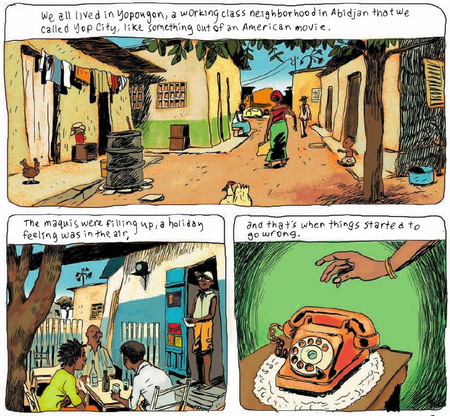

Reading this novel was a bittersweet experience. The normal, everyday events of Main Street in Yop City are explored. The characters are relatable and recognizable and could live on Main Street USA: People gossiping and playing cards while enjoying a beer. Rotary phones on doilies on occasional tables.Laundry drying in the midday sun. What struck me the most was the knowledge that this ordinary city, with ordinary people, is almost unrecognizable in large swaths of Africa today. It is because of this that the novel is so important. Without these glimpses into the ordinary lives of Africans, we wouldn't have any other reference than the war-torn, politically unstable Africa of today.
In many ways, this novel is more than just a novel of ordinary people doing ordinary things and living a sometimes unremarkable life. It also serves as an anthropological find: An African city on the Ivory Coast, unearthed, with normal people doing normal things just like anyone else in the world.

Abouet, M Aya: Life in Yop City Gallimard, 2005
McCloud, S Understanding Comics: The Invisible Art Harper, 1993
Marguerite Abouet's Aya lives an interesting life as a ninteen-year-old hoping to go to school. Her friends have different aspirations and dreams. One has a baby, one wants a wealthy boyfriend or husband. All live in the colorful, vibrant city of Yop. The colors jump off the page and the reader can feel the busy, noisy streets and hear the people talking and moving about. Reading this book was a feast for the senses. McCloud defines this method in Understanding Comics as using " color as sensation, color as environment, color as color." (McCloud pp 191) Life in Yop City uses color to express the vibrancy and 'life' of the city. If there were no words, a powerful message about the fullness of life would still be conveyed. McCloud explains this as the ability of color to "take on a central role"( McCloup pp 190) and the way color can "express a dominant mood" and allow "whole scenes to be virtually about color" ( McCloud pp 190). Looking at the colorful panels reminds me of the comic frames that begin as a still, and morph into a live scene. This novel is so beautifully illustrated, by the author's French ex-husband, that I wonder how her memory of the setting was conveyed so expertly to someone outside of her experience.
Reading this novel was a bittersweet experience. The normal, everyday events of Main Street in Yop City are explored. The characters are relatable and recognizable and could live on Main Street USA: People gossiping and playing cards while enjoying a beer. Rotary phones on doilies on occasional tables.Laundry drying in the midday sun. What struck me the most was the knowledge that this ordinary city, with ordinary people, is almost unrecognizable in large swaths of Africa today. It is because of this that the novel is so important. Without these glimpses into the ordinary lives of Africans, we wouldn't have any other reference than the war-torn, politically unstable Africa of today.
In many ways, this novel is more than just a novel of ordinary people doing ordinary things and living a sometimes unremarkable life. It also serves as an anthropological find: An African city on the Ivory Coast, unearthed, with normal people doing normal things just like anyone else in the world.
Abouet, M Aya: Life in Yop City Gallimard, 2005
McCloud, S Understanding Comics: The Invisible Art Harper, 1993
Comments
Post a Comment